



Treatment at Psymate Clinic
Precision-led. Data-driven. Integrative.
Treatment at Psymate Clinic
Precision-led. Data-driven. Integrative.
At Psymate Clinic, treatment is not a set of parallel options.
It is a clinically governed process, guided by psychiatric expertise, supported by data, and personalised to the individual.
We do not ask “Which treatment do you want?”
We ask “What does this person need—at this stage, in this context?”
OUR TREATMENT PHILOSOPHY
Mental health care demands judgment, not templates.
Every treatment decision at Psymate is based on:
Comprehensive clinical assessment
Longitudinal symptom tracking
Functional and developmental context
Prior treatment response
Risk–benefit evaluation
The psychiatrist plays the central role—integrating clinical data, patient experience, and evidence—to design a precise and evolving treatment plan. No single modality is treated as superior. Integration is preferred.
THE ROLE OF THE PSYCHIATRIST (CENTRAL TO CARE)
At Psymate, the psychiatrist functions as:
Clinical integrator, not just a prescriber
Diagnostic authority, not a referral gateway
Ethical gatekeeper for technology and medication
Longitudinal steward of the care journey
Treatment choices are:
Data-informed, not trend-driven

Personalised, not protocol-bound

Reviewed continuously, not fixed at intake
This ensures precision without rigidity—and care without excess.
CORE TREATMENT APPROACHES
Pharmacotherapy (Medication Management)
Medication is used deliberately and judiciously, as one component of care. At Psymate:
Medication follows diagnosis—not symptoms alone
Lowest effective dose is preferred
Side effects are actively monitored
Long-term dependence is avoided where possible
Medication plans evolve with recovery
Pharmacotherapy is never isolated from psychological or functional understanding.
Psychotherapy (Evidence-Based & Depth-Oriented)
Psychotherapy is integrated as a core pillar, not an adjunct.
Therapy selection is based on:
Condition profile
Individual personality and coping style
Developmental stage
Phase of illness or recovery
Psychotherapy works in tandem with psychiatric oversight to support:
Emotional regulation
Insight and meaning-making

Behavioural change

Relapse prevention
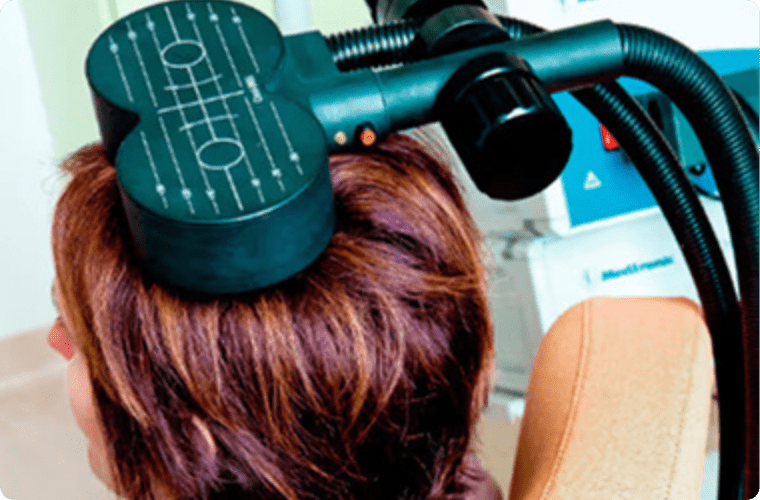
Neuromodulation (Precision Brain Stimulation – rTMS)
Neuromodulation at Psymate represents technology serving clinical judgment, not replacing it.
rTMS is positioned as:
A precision tool to modulate dysfunctional neural circuits
An option where medications are ineffective, poorly tolerated, or insufficient
A complement to ongoing psychiatric and psychological care
Key principles:
Psychiatrist-led indication
Data-guided targeting and protocols

Continuous outcome monitoring
Ethical restraint in use
Neuromodulation is not limited to “last-resort” care—it is applied strategically, where it adds value without systemic side effects of psychotropics.
INTEGRATIVE TREATMENT PATHWAYS (THE DEFAULT)
At Psymate, integration is the norm, not the exception.
Psychiatric formulation
Selective pharmacotherapy
Structured psychotherapy
Neuromodulation where indicated
These are combined into personalised care pathways, reviewed and refined over time.
Integration allows:
Faster stabilisation
Reduced medication burden
Better functional recovery
Lower relapse risk
HOW TREATMENT EVOLVES OVER TIME
Treatment is dynamic, not static.
You can expect:
Initial assessment & formulation
Early stabilisation phase
Consolidation & skill-building
Recovery & relapse prevention
Long-term follow-up as needed
Care adapts as you do.
SAFETY, ETHICS & GOVERNANCE
All treatment decisions are governed by:
Informed consent (ongoing, not one-time)
Defined clinical protocols
Outcome tracking and review
Ethical oversight
Innovation is welcomed—but never without responsibility.
BEGIN WITH UNDERSTANDING
Treatment begins with clarity, not commitment.
If you are considering care, start with a consultation to understand what combination of approaches is appropriate for you.